

This document provides guidance on pesticide treatments for controlling Little Fire Ants (LFA) and Coconut Rhinoceros Beetles (CRB), including types, pros and cons, and common active ingredients.
- Little Fire Ant treatments: Broadcast baits are spread over wide areas and target entire colonies but may miss ants in tall vegetation. Gel baits can be applied directly to foliage, improving contact with colonies but may clog equipment. Chemical barriers repel or kill ants on contact but do not eliminate queens, allowing colonies to persist. These methods should not be used simultaneously. Common active ingredients include hydramethylnon, methoprene, spinosad, indoxacarb, bifenthrin, and gamma-cyhalothrin.
- Coconut Rhinoceros Beetle treatments: Trunk injections use systemic insecticides for whole-tree protection with long residual effects but require specialized equipment and flower trimming to protect pollinators. Soil drench treatments also provide systemic protection with simpler application but pose higher water contamination risks and have application limits. Crown/foliar sprays act quickly and are suitable for palms showing recent infestation but have short residual effects and higher drift risk. Active ingredients include imidacloprid, acephate, pyrethrins, and pyrethroids.
- Usage considerations: For both pests, certain treatments have restrictions such as not eating fruit post-application and trimming flowers to protect pollinators. Some pesticides require special permits or are not available in all regions. Proper label directions should always be followed, and the Department of Agriculture and Biosecurity does not endorse or disapprove listed products.
Disclaimer:
The inclusion of a product on this list is NOT an endorsement by the Department of Agriculture and Biosecurity (DAB). Likewise, the exclusion of a product from this list is NOT a sign of disapproval by DAB. Products listed are examples for educational purposes only. DAB makes no claim as to the effectiveness or safety of any products listed. For more detailed information on Pesticide use in Hawai’i please click this link.
Pesticide products must be registered with the Environmental Protection Agency (EPA) and DAB before they can be sold, distributed, and used within the State of Hawai`i.
Application of pesticides via drone requires specific licenses from the United States Federal Aviation Administration (FAA).
The label is the law. Always follow all applicable label directions.
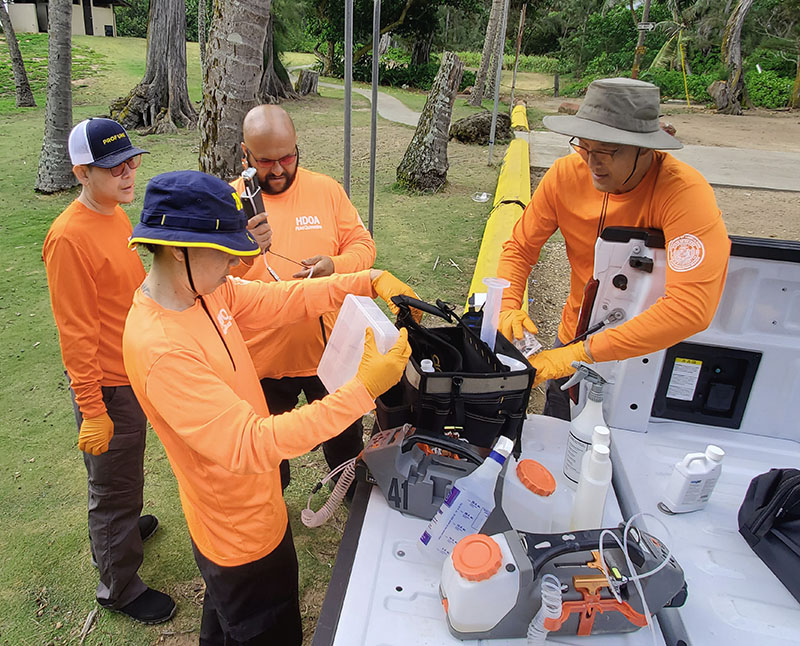
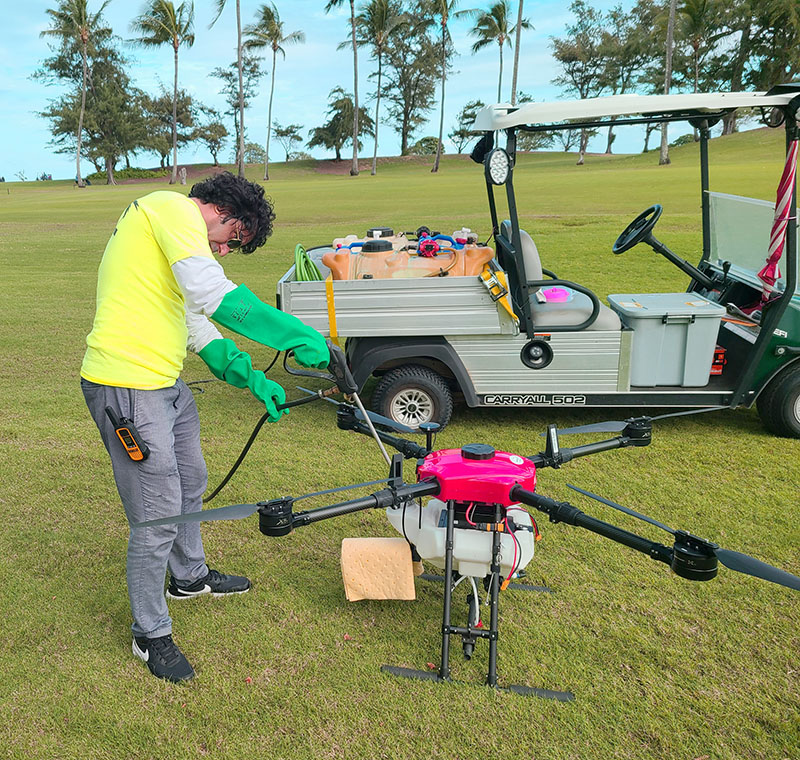
Pesticide Treatments for Little Fire Ants (LFA)
| Broadcast Bait | Gel Bait | Barrier | |
| Overview | Bait meant to be dispersed over a widespread horizontal area. Should not be used simultaneously with chemical barriers. | Bait meant to be applied to vegetation and foliage. Should not be used simultaneously with chemical barriers. | Chemical barrier meant to kill or repel ants that contact it. Should not be used simultaneously with baits. |
| Pros | Targets entire colony. Relatively simple application. | Targets entire colony. Can apply directly to vegetation, increasing chance of contacting LFA colonies. | Prevents ants from entering protected areas. Relatively simple application. |
| Cons | Does not specifically target LFA colonies which commonly form in tall vegetation. | Thick gel consistency can clog application equipment. | Does not target the queen; the colony may continue to reproduce. |
| Common Active Ingredient(s) and Examples* *No endorsement is made for any product listed, nor is any disapproval intended for any similar unlisted products. Products include but are not limited to: | Hydramethylnon: AMDRO Fire Ant Killer for Moundsv (EPA reg no. 73342-1-90098), ProBait Formulation for Professionals (EPA reg no. 73342-1-2724), Maxforce Complete Brand Granular Insect Baitv (EPA reg no. 432-1255). Spinosad: Antixx Fire Ant Bait (EPA reg no. 67702-56). Metaflumizone: Siesta Insecticide Fire Ant Bait (EPA reg no. 7969-232). Methoprene: | Hydramethylnon: Methoprene: Tango (EPA reg no. 2724-420). Indoxacarb: Advion WDG (EPA reg no. 100-1501); special local need label available | Bifenthrin: Talstar PL Granular Insecticide (EPA reg no. 279-3168), Bifen IT (EPA reg no. 53883-118). Indoxacarb: Gamma-Cyhalothrin: Spectracide Bug Stop Home Barrier (EPA reg no. 9688-298-8845). |
Pesticide Treatments for Coconut Rhinoceros Beetle (CRB)
| Trunk Injections | Soil Drench | Crown/Foliar Spray | |
| Overview | Systemic insecticide protects entire tree via injection. | Systemic insecticide protects entire tree via root uptake. | Direct application of insecticide to crown. |
| Pros | Low probability of drift. Ideal for large scale operations. Long residual effect. | Ideal for young palms that may be damaged by trunk injections. Relatively fast and simple. Long residual effect. | Ideal for palms with recent signs of infestation. Immediate effect. Relatively fast and simple. |
| Cons | Must trim off flowers to prevent effects on pollinators. Cannot eat fruit. Delayed effect due to translocation. Requires specialized equipment. | Must trim off flowers to prevent effects on pollinators. Cannot eat fruit. Delayed effect due to translocation. Higher risk of water contamination. Maximum application rate restrictions may limit large scale operations. | Requires access to crown (i.e. drone, access lift, etc.). Higher risk of drift due to height of application. Short residual effect. |
| Common Active Ingredient(s) and Examples* *No endorsement is made for any product listed, nor is any disapproval intended for any similar unlisted products. Products include but are not limited to: | Imidacloprid: IMA-jet (EPA reg no. 74578-1), Merit 75 WSP (EPA reg no. 101563-62). Acephate: ACE-jet (EPA reg no. 74578-2). | Imidacloprid: Merit 75 WSP (EPA reg no. 101563-62). | Pyrethrins/pyrethroids: EVERGREEN Pyrethrum Concentrate (EPA reg no. 1021-2560), *Mustang Maxx (EPA reg no. 279-3426), **Demon Max (EPA reg no. 100-1218). Multimodal: OneGuard (EPA reg no. 1021-2807). |
*Restricted use pesticide
**Section 18 Emergency Exemption required on ornamental palm crowns; not available on Oahu
Treatment for Coqui Frogs
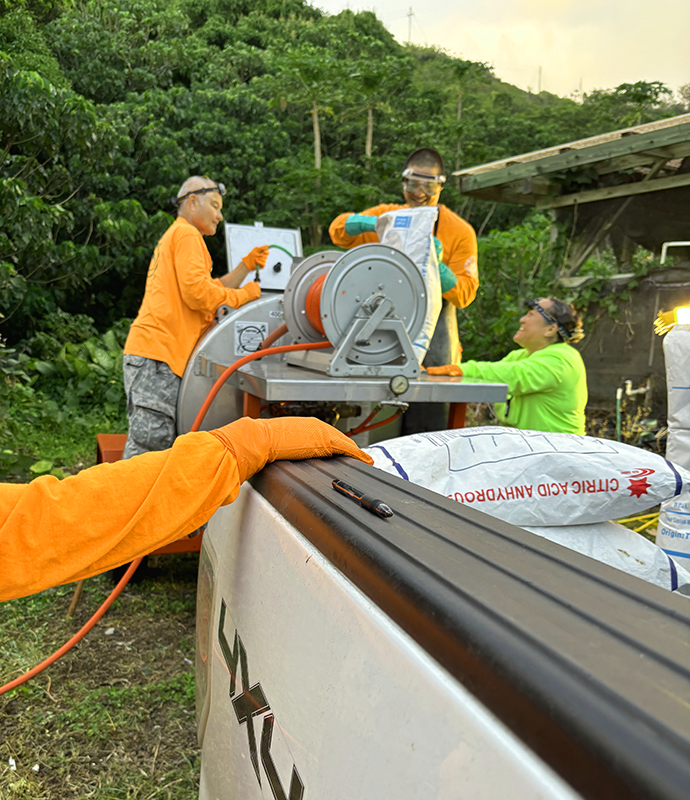
Citric acid is one of the active ingredients that the EPA considers minimum risk. Minimum risk pesticide products are exempted from FIFRA registration and usually do not have the strict guidelines and product label requirements that conventional pesticide products have.
There is not a product label or list of products containing citric acid. The Department of Agriculture and Biosecurity does not register minimum risk products. Instead, there are CTAHR and DAB publications on how to mix commercially available citric acid into pesticidal concentrations.
| Citric Acid Spray | |||
| Overview | Systemic insecticide protects 16% citric acid can be used in spray applications to coqui frog-infested habitat to kill adults, juveniles, and eggs. | ||
| Pros | Can cause damage to sensitive plants. Known sensitive plants include: mock orange, orchids, air plants, anthurium, calathea, and streptocarpus. To minimize damage to plants, it is recommended to test a small area for sensitivity or wash treated areas with fresh water one hour after application. Little to no residual effect. Highly concentrated citric acid can have corrosive/irritative properties. | ||
| Cons | Can cause damage to sensitive plants. Known sensitive plants include: mock orange, orchids, air plants, anthurium, calathea, and streptocarpus. To minimize damage to plants, it is recommended to test a small area for sensitivity or wash treated areas with fresh water one hour after application. Little to no residual effect. Highly concentrated citric acid can have corrosive/irritative properties. | ||
| Common Active Ingredient(s) and Examples* *No endorsement is made for any product listed, nor is any disapproval intended for any similar unlisted products. Products include but are not limited to: | Citric acid: Citric acid, anhydrous is available commercially. To mix a 16% solution, mix 1.3 lbs (Approximately 2 ¾ of a cup) of anhydrous citric acid per gallon of water. Spray where pests are suspected. It is suggested to make applications every two weeks (About the time it takes for eggs to hatch) until control is achieved. It is recommended to spray in the early evening when male frogs begin to call. Follow all pertinent safety precautions. Eye protection, such as chemically resistant goggles or a face shield, and skin protection, such as chemically resistant gloves, is strongly recommended. |
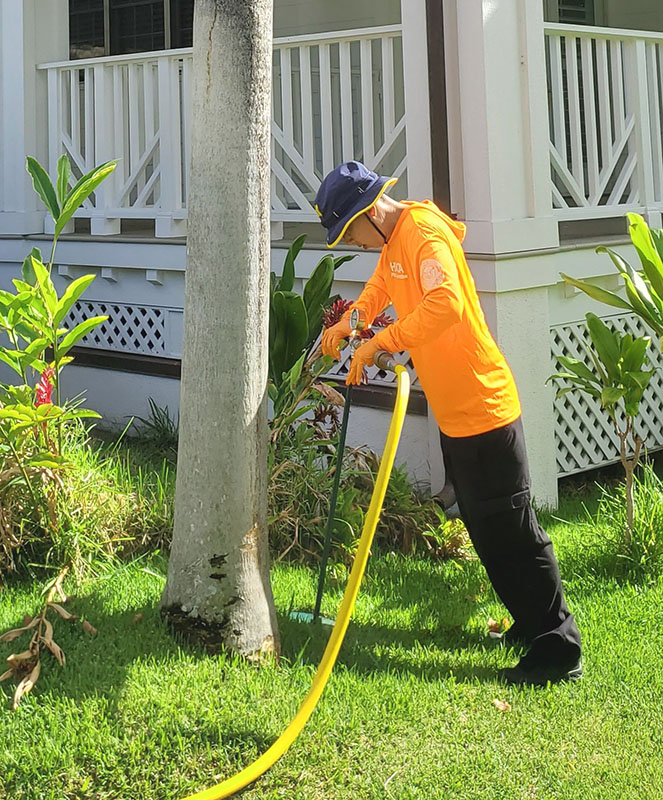
Department of Agriculture and Biosecurity’s Pesticide Branch.